A New Day of Learning

Saturday, February 8, 2014

Subject and Predicate Snowman


All of the classes in fourth grade at my school have been working hard on what makes a complete sentence.  We have been studying run-on sentences, sentence fragments and subjects and predicates. As we were wrapping up our study of subjects and predicates, we thought it would be fun to have an end product that the students made together.

We were inspired by this blog post from Owl See You in Third Grade about using sentence strips to make pumpkins  Since, we were studying subject and predicate after it had snowed, we thought that making snowmen might be more appropriate.

We gave each student a couple of sentence strips and had them write a complete sentence. Then we had them circle the subject and underline the predicate in each sentence.  When they were finished, we collected the strips and displayed some of them under the document camera.  The students were so creative when they wrote their sentences.  We laughed for a long time as we reviewed the subject and predicate in each sentence that was displayed.

After we reviewed, we started to link the strips together in to a chain.  Then we stapled the chains in the shape of a snowman onto a bulletin board.  Check out my coworker's display in the hallway.  She had her students decorate it! Didn't it turn out SUPER cute?
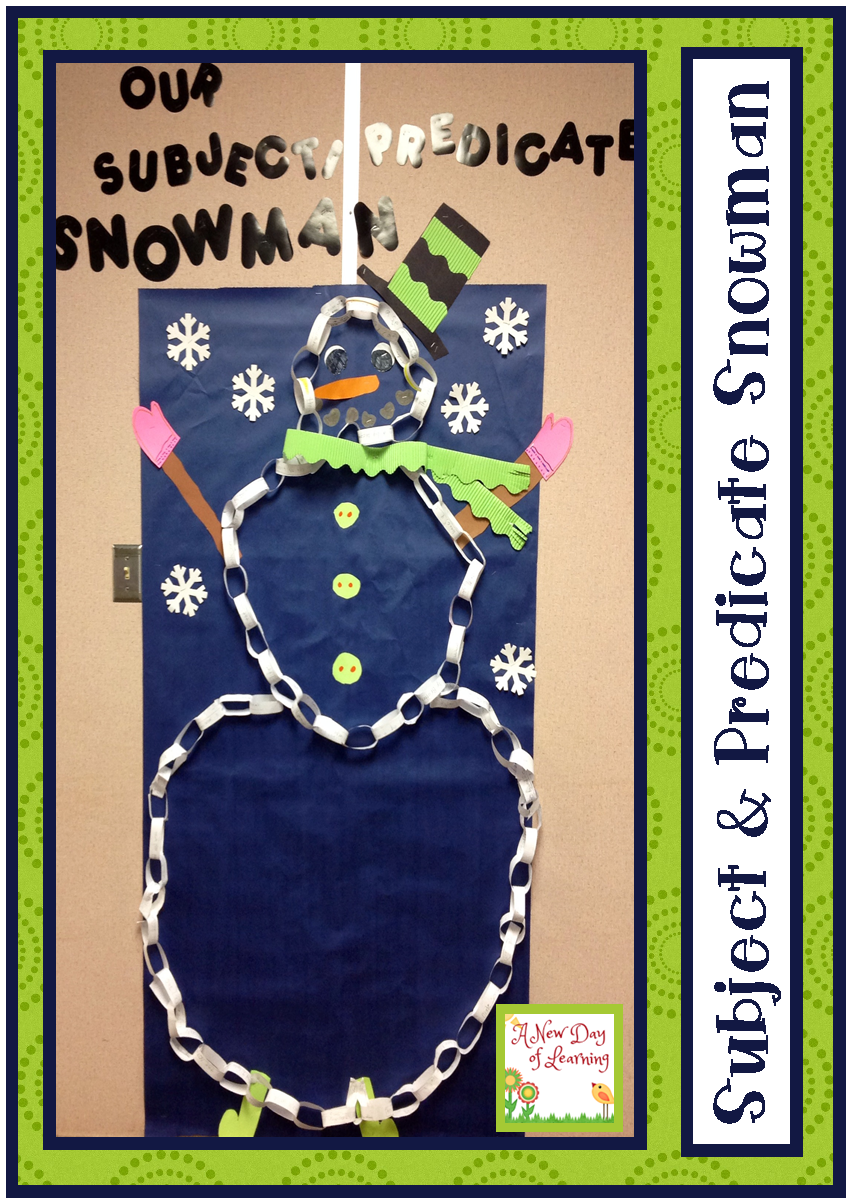
http://bit.ly/1bGoZz3 

Click on the picture to get your FREE sentence strip templates to make your own subject and predicate snowman! (Be sure to be logged into your Google account.)

If you don't have a Google account, you can download it from my Teachers Pay Teachers store.

I am linked up this week at

Classroom Freebies Manic MondayFreebie Fridays


What is your favorite way to teach subject and predicate?


Saturday, February 1, 2014

Square Root Clock Cards


A few years ago I came across this great idea on Pinterest to put square root cards around the outside of a clock.  Click here to see my inspiration. I noticed that during STAR Math testing, quite a few students were asking me what the square root symbol was.  I, of course, told them that I couldn't help them, but quickly made a mental note to give them a quick lesson on square root.  Teaching square root is not a fourth grade standard, but many of my students are able to grasp the concept easily with one short lesson using the clock and the square root cards.

I made some cute little cards, laminated them, and then used velcro to attach them to the outside of my clock.  On occasion, my students and I review what square roots are and we use the clock to help us!

http://bit.ly/1gAAPPx 

If you would like your own set of square root clock cards, just click on the picture above! (Remember to be logged into your Google account.) 

If you don't have a Google account, you can download them from my Teachers Pay Teachers store.

This week I am linked up at 
Classroom Freebies Manic MondayFreebie Fridays


How do you teach square roots?


Thursday, January 30, 2014

It's My Birthday!


My birthday is this weekend and to celebrate I thought I would give YOU a gift!  All you have to do is visit my Facebook Page and click on the Birthday Freebie Tab! I hope you enjoy it!

https://www.facebook.com/anewdayoflearning


Sunday, January 26, 2014

Fraction Action

I just introduced fractions to my math R.T.I. group and thought it would be a good idea to review some vocabulary with them.  I dug out this Forever Freebie and put it in my plans for next week.

It is a super fun game that you play using your smartboard.  You divide the students into two teams.  Have one student from each team come up and give them each a flyswatter.  Display one of the slides of the PowerPoint and have the students should swat the word that matches the picture.  The person who swats it first, earns a point for their team.  Then have two new students come up and the game continues.

The students have such a blast playing this! I can't wait until Thursday when my students get to play!

You can download your copy by clicking on the picture below! Make sure you are logged into your Google account.


https://drive.google.com/file/d/0B1Vgd-Q36N9ieVZMM2dmWXhDZ2c/edit?usp=sharing


If you don't have a Google account, you can download
Word Attack Fractions from my 

I am linked up this week at:
Classroom Freebies Manic MondayFreebie Fridays


What strategies do you have for introducing fractions?
 

Wednesday, January 22, 2014

Equal or Not?

In math class yesterday we studied equalities and inequalities.  I used the analogy of a balance to show them that equalities must be equal on each side. We drew pictures of balance scales, like the one below, and practiced equations that were equal and not equal. 


When I felt like they had a good understanding, we played a game. I made this game using using super cute dog clip art from Ashley Hughes.   I gave each student a piece of paper that had equal and not equal signs on it. (see photo below)  The symbols were made out of dog bones and the students thought it was the best!


Next, I displayed a problem on the SmartBoard using the document camera.  The students would do the work on their whiteboards. On my count, they would hold up either their equal or not equal sign.   Then one of them would come up and use smaller versions of the dog bones to make the equations equal or not equal.


To really test their knowledge and understanding, we ended the lesson with a fun craftivity.  The students were each given a large dog bone to cut out. They were asked to write an equality and an inquality on the inside of the dog bone.  (see photo below)  They used dog bones in bowls like the photo above to show whether their equations were equal or not.  


When they were all finished, I put together a super cute bulletin board to display their excellent work!


If you would like to do this game and craftivity in your classroom, it is available in my  


What strategies do you use to teach equalities and inequalities?


Sunday, January 19, 2014

Testing Survival Kits

I would bet at some point you have all felt the pressure of finding your students' reading levels! In order to help my team power through our Fountas and Pinnell testing I went to work whipping up some Testing Survival Kits for them!


I left them in their rooms for them so they were greeted on Monday morning by a welcoming and bright container of goodies! Do you feel like your team could use a little boost?  If so, click below to download the FREE templates to make your own Testing Survival Kit! (Remember to log in to your Google account!)

http://bit.ly/1h57HvX

If you don't have a Google Account, you can download The Testing Survival Kit from my


What do you do to celebrate testing?


Wednesday, January 15, 2014

Do You Close Read?

I am wondering how many of you do Close Reading in your classroom?  If you do, how do you approach it? Have you had amazing or lackluster results?

I have just started doing close reading in my classroom a few weeks ago.  So far, my students have been very engaged and have reported greater understanding in what they have been close reading.  Those are things I love to hear!

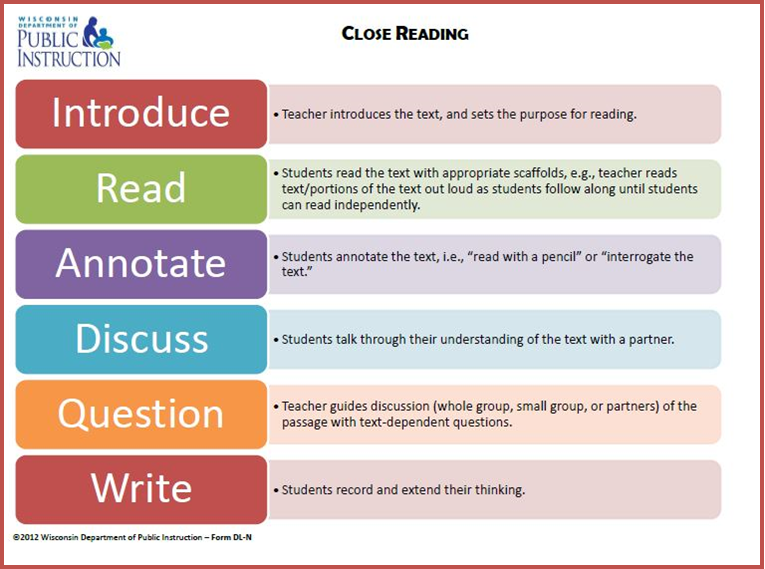
I thought I would take minute and share how I have approached it in my classroom.   I started with the document below that I found at the Wisconsin Department of Public Instruction's website. I used this to help me plan my instruction.

http://www.google.com/url?sa=t&rct=j&q=&esrc=s&source=web&cd=1&ved=0CC4QFjAA&url=http%3A%2F%2Fstandards.dpi.wi.gov%2Ffiles%2Fcal%2Fpdf%2Fclose-reading.pdf&ei=-6fRUqbTI8ikqQGR5oHYBQ&usg=AFQjCNFekFP8ZsBq8AIbvKWeuTpS7IWj5w&sig2=7C1wyMg4e9QpF_fa4gw2yg&bvm=bv.59026428,d.aWM

Next, I went in search of a good anchor chart to help teach my students what to do while they close read.  I went straight to my good friend Theresa of Trifecta Book Reviews.  She recommended that I take a look at Tracy Watanabe's website.   I went and I found exactly what I was looking for. Here is my chart next to her original chart. Click on her chart to go to her post!


I picked out a Social Studies passage to go along with our study of Ellis Island and then introduced the concept of close reading to my class.  I modeled for them how to do the steps and then set them free to try it.  Here are some pictures of their papers after their first close read.

I am pretty proud of how well they did after only a short mini-lesson.  They were able to make connections, identify words they didn't know, and write down questions they still had.  Even better, we had a great conversation about the article after the close read. 


How do you do close reading your classroom?
What are you favorite resources to use?


Related Posts Plugin for WordPress, Blogger...
 
Back to the Top